The Woman Who Kept the Light On series
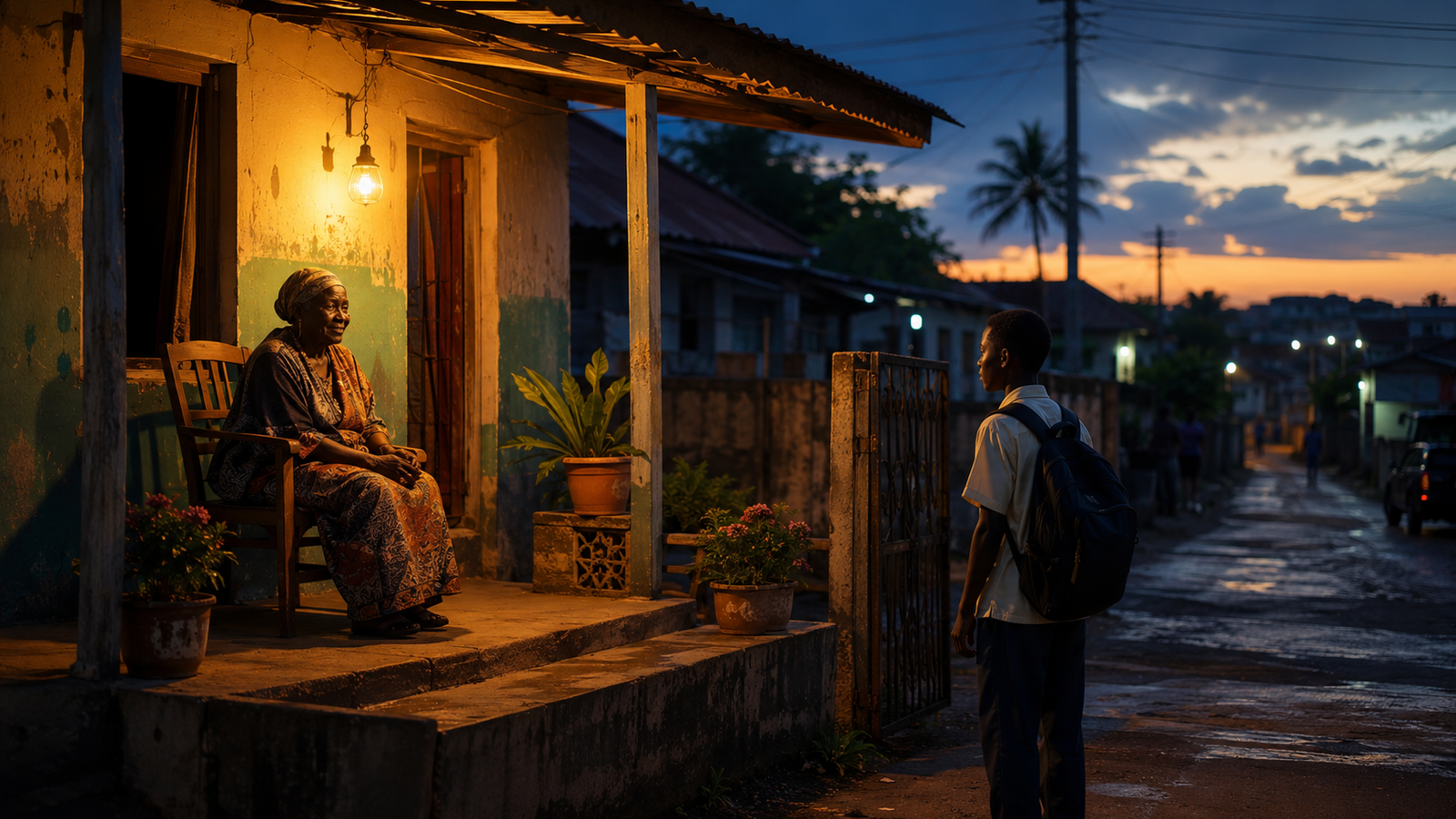
Every evening, at exactly seven o’clock, Mrs. Adeline turned on the small yellow bulb outside her front door.
It was not a bright light. It did not flood the street or chase the darkness away. It only made a soft circle on the old veranda, touching the flower pots, the wooden chair, and the faded welcome mat that had been there for more years than anyone could remember.
People in the neighborhood were used to it.
When the sky grew dark, her light came on.
Rain or harmattan, power cuts or lonely nights, Mrs. Adeline always found a way. Sometimes she used the bulb. Sometimes she used a lantern. On nights when the electricity failed completely, she placed a candle inside a glass jar and set it near the door.
No one really asked why.
Most people assumed it was a habit from old age. Some said she was afraid of darkness. Others said she was waiting for someone who would never return.
Only one person cared enough to wonder.
His name was Daniel.
Daniel was sixteen, quiet, and always walking home later than he should. His mother sold food by the roadside, and after school he helped her wash plates, pack tables, and carry the cooler back home. By the time he passed Mrs. Adeline’s house, the street was usually dark.
But her light was always there.
At first, he did not think much of it. Then, one evening, after a heavy rain had turned the road muddy and the whole area had lost power, he saw the candle glowing on her veranda. It was small, but it helped him see the broken edge of the gutter just before his foot slipped into it.
He stopped.
For the first time, he looked at the house properly. The curtains were drawn. The paint had peeled around the windows. The compound was swept clean, but it had the silence of a place where laughter had not visited in a long time.
The next evening, Daniel slowed down when he passed.
Mrs. Adeline was sitting outside, wrapped in a blue shawl, her hands folded over a walking stick. Her hair was white, but her eyes were sharp.
“Good evening, ma,” Daniel greeted.
She looked at him and smiled. “Good evening, my son. You are the boy who walks home late.”
Daniel felt shy. “Yes, ma.”
“You should be careful on this road. The gutter near the mango tree is broken.”
“I know, ma. Your light helped me yesterday.”
Her smile became softer. “Then it is doing its work.”
Daniel wanted to ask what she meant, but he only nodded and continued walking.
After that day, greeting her became part of his evening. Sometimes she waved. Sometimes she asked about school. Sometimes she gave him oranges from the tree behind her house. Daniel began to notice that nobody else stopped for long. People greeted her from a distance, but they were always in a hurry.
One Friday evening, Daniel passed and saw that the light was off.
He stopped immediately.
The veranda was dark. The chair was empty. The flower pots sat like shadows near the wall.
Something felt wrong.
Daniel stood by the gate and called, “Mrs. Adeline?”
No answer.
He called again, louder this time.
After a moment, he heard a weak sound from inside the house.
Daniel pushed the gate. It was not locked. His heart beat fast as he stepped into the compound and knocked on the front door.
“Ma?”
The voice came again, faint and strained. “Daniel?”
He opened the door slowly.
Mrs. Adeline was on the floor near the passage, one hand pressed against her side. Her walking stick lay a few steps away.
Daniel froze for half a second, then ran to her.
“I fell,” she whispered. “I was trying to light the lantern.”
Daniel rushed to call his mother. Within minutes, neighbors gathered. Someone brought a car. Someone called the clinic. Someone lifted Mrs. Adeline carefully and carried her out.
That night, the whole street stood in front of her house, talking in worried voices.
For the first time in years, the veranda was full.
Mrs. Adeline returned home three days later with a bandaged arm and strict instructions to rest. Daniel and his mother cleaned the house before she came back. The neighbors repaired the broken gutter near the mango tree. Someone fixed her front door. Someone changed the weak bulb outside her veranda.
When evening came, Daniel arrived with a new lantern.
Mrs. Adeline laughed when she saw it. “So you people want to take over my work?”
Daniel smiled. “No, ma. We just want to help you keep doing it.”
She looked at him for a long moment. Her eyes shone, but no tears fell.
“Do you know why I keep that light on?” she asked.
Daniel shook his head.
“My husband started it,” she said quietly. “Years ago, many children used this road to return from lesson. The street was darker then. One night, a little girl fell into that broken gutter and hurt her leg badly. My husband said no child should pass our house in darkness again.”
She touched the arm of her chair.
“After he died, I kept the light on. At first, it was for him. Later, it was for the road. Then, maybe, it was for myself too.”
Daniel sat beside her, listening.
Mrs. Adeline looked toward the street. “People think a small light does not matter. But sometimes, a small light is enough to stop someone from falling.”
That sentence stayed with Daniel.
From that day on, the light outside Mrs. Adeline’s house became more than a habit. It became something the whole neighborhood protected. If the bulb went bad, someone changed it. If the lantern needed kerosene, someone brought some. If Mrs. Adeline was tired, Daniel lit it before going home.
Months passed.
The street changed in small ways. People greeted one another more. Children played closer to the houses. The broken parts of the road were fixed little by little. On some evenings, neighbors gathered on Mrs. Adeline’s veranda just to talk.
Her house no longer felt forgotten.
One night, Daniel walked home after receiving his school result. He had passed well, better than anyone expected. His mother cried when she saw the result, and for the first time in a long while, Daniel allowed himself to believe that his future might be bigger than the street he walked every day.
As he passed Mrs. Adeline’s house, she called him.
“My son.”
He went to the veranda.
She pointed at the light above the door. “Do you see it?”
Daniel nodded.
“One day, you must become that kind of person,” she said. “Not loud. Not proud. Just useful. A person who helps others see where to place their feet.”
Daniel looked at the small yellow bulb glowing above them.
It was still not bright enough to light the whole street.
But it was enough.
And sometimes, enough is what saves a person.