The Boy Who Carried Water series
The Boy Who Carried Water
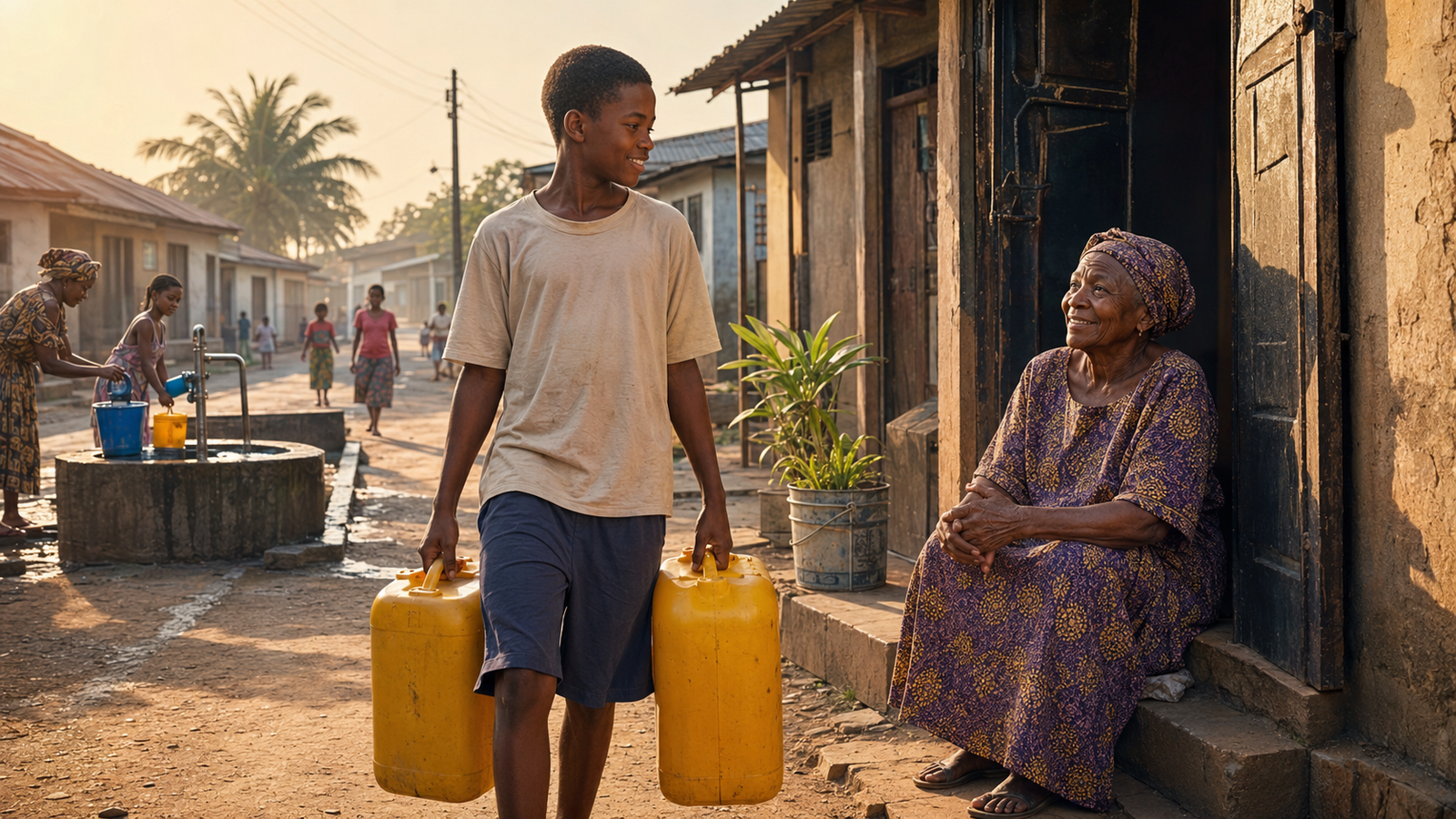
Every morning before the sun fully opened its eyes, Samuel carried two yellow jerrycans to the old borehole at the end of the street.
He was only fifteen, but his shoulders already knew the weight of responsibility. One jerrycan was for his mother. The other was for their neighbor, Mama Ruth, an elderly woman who lived alone in the small house beside theirs.
At first, Samuel did not like it.
The borehole was far, the queue was always long, and the handles of the jerrycans bit into his palms. Some mornings, he watched other boys his age walking freely to the football field, laughing, pushing one another, talking about matches and school gossip.
Samuel wanted to join them.
Instead, he carried water.
“Why must I fetch for Mama Ruth every day?” he asked his mother one morning.
His mother looked up from the pot she was washing. “Because she cannot carry it herself.”
“But she has children.”
His mother became quiet for a moment. “Yes. But they are not here.”
Samuel did not argue again, but his heart was not happy. He fetched the water, dropped Mama Ruth’s jerrycan by her door, and left before she could thank him.
Every day was the same.
Then one Saturday, the borehole broke down.
People stood around it, angry and tired. Some carried empty buckets back home. Others walked to the next street, where another borehole was said to be working. Samuel followed them, dragging the two empty jerrycans behind him.
The next borehole was even farther. By the time he filled both jerrycans, the sun was hot and his shirt was soaked with sweat. He carried one jerrycan a few steps, dropped it, went back for the second, and repeated the process until he reached home.
His arms trembled.
When he got to Mama Ruth’s door, she was sitting outside, waiting.
“Samuel,” she said softly, “you went all that way?”
He nodded, too tired to speak.
Mama Ruth looked at the jerrycan, then looked at him. Her eyes were full of something he did not understand.
“God bless you, my son,” she said.
Samuel shrugged and turned to leave.
“Wait.”
She reached beside her chair and brought out a small bowl covered with a plate. Inside were two pieces of fried yam and pepper sauce.
“I kept this for you.”
Samuel wanted to say no, but the smell reached him first. He sat on the low step and ate quietly.
That was the first day he stayed.
Mama Ruth told him stories while he ate. She told him about the old days, when the street was mostly bush and children played under mango trees. She told him about her husband, who used to repair radios. She told him about her three children, all living far away, calling when they could, sending money when they remembered.
Samuel listened.
After that day, he no longer dropped the water and ran away. Sometimes he sat for five minutes. Sometimes ten. Sometimes Mama Ruth gave him groundnuts, sometimes oranges, sometimes nothing at all except stories.
Slowly, the chore stopped feeling like punishment.
One afternoon, Samuel came home from school looking sad. He had failed a mathematics test badly, and his teacher had said he was not serious.
Mama Ruth noticed his face immediately.
“What happened?”
“Nothing.”
She smiled. “Nothing does not bend a person’s head like that.”
Samuel sat beside her and told her everything.
Mama Ruth listened without interrupting. When he finished, she pointed at the jerrycan near her door.
“Do you remember when you first started carrying water for me?”
Samuel nodded.
“You could barely carry one without stopping.”
He smiled a little. “It was heavy.”
“But now?”
“Now it is still heavy.”
“Yes,” she said. “But you are stronger.”
Samuel looked at her.
“Some things do not become easy because the load changes,” Mama Ruth said. “They become easier because the person carrying them grows.”
The words stayed with him.
That evening, Samuel opened his mathematics book again. He did not understand everything at once, but he tried. The next day, he asked a classmate to explain the topic. The day after that, he practiced more questions.
He still carried water every morning.
He still got tired.
But now, whenever his palms hurt, he remembered Mama Ruth’s words.
Months passed, and something began to change on the street. People noticed Samuel helping Mama Ruth every day. One woman started sending food to an old man two houses away. A shopkeeper began allowing schoolchildren to refill their bottles for free. A group of boys repaired the broken bench near the roadside.
No one announced it.
No one called a meeting.
Kindness simply started moving from one house to another.
One evening, Samuel returned from school and saw a small crowd in front of Mama Ruth’s house. His heart jumped. He ran through the gate and found her sitting in her chair, smiling widely.
Her eldest son had come home.
He was a tall man with tired eyes and a suitcase in his hand. When he saw Samuel, he stood up.
“You are Samuel?”
Samuel nodded.
The man held his hand with both of his. “My mother has told me about you.”
Samuel felt shy. “I only helped with water.”
The man shook his head. “No. You helped with loneliness too.”
Samuel did not know what to say.
That night, Mama Ruth’s house was full of voices. Her son cooked rice. Neighbors came in and out. Someone brought drinks. Someone brought music from a small speaker. For the first time since Samuel had known her, Mama Ruth laughed so loudly that people on the road turned to look.
The next morning, Samuel still woke up early.
He picked up the jerrycans out of habit, but when he stepped outside, Mama Ruth’s son was already there.
“I will fetch today,” the man said.
Samuel stood uncertainly.
Mama Ruth, sitting by the window, called out, “Let him go, Samuel. Even helpers must rest.”
Samuel smiled and handed over the jerrycans.
For the first time in many months, his hands were empty in the morning.
He could have gone back to sleep. He could have gone to the football field. Instead, he walked slowly down the street, looking at the houses, the gates, the people beginning their day.
Near the corner, he saw a little girl struggling with a bucket that was too big for her.
Samuel stopped.
“Do you need help?” he asked.
The girl nodded.
Samuel lifted the bucket easily.
It was heavy, but not too heavy.
And as he carried it down the road, he understood something simple and beautiful.
A person does not need to change the whole world at once.
Sometimes, carrying one bucket for someone is enough to begin.