The Day I Failed—and Finally Found My Purpose
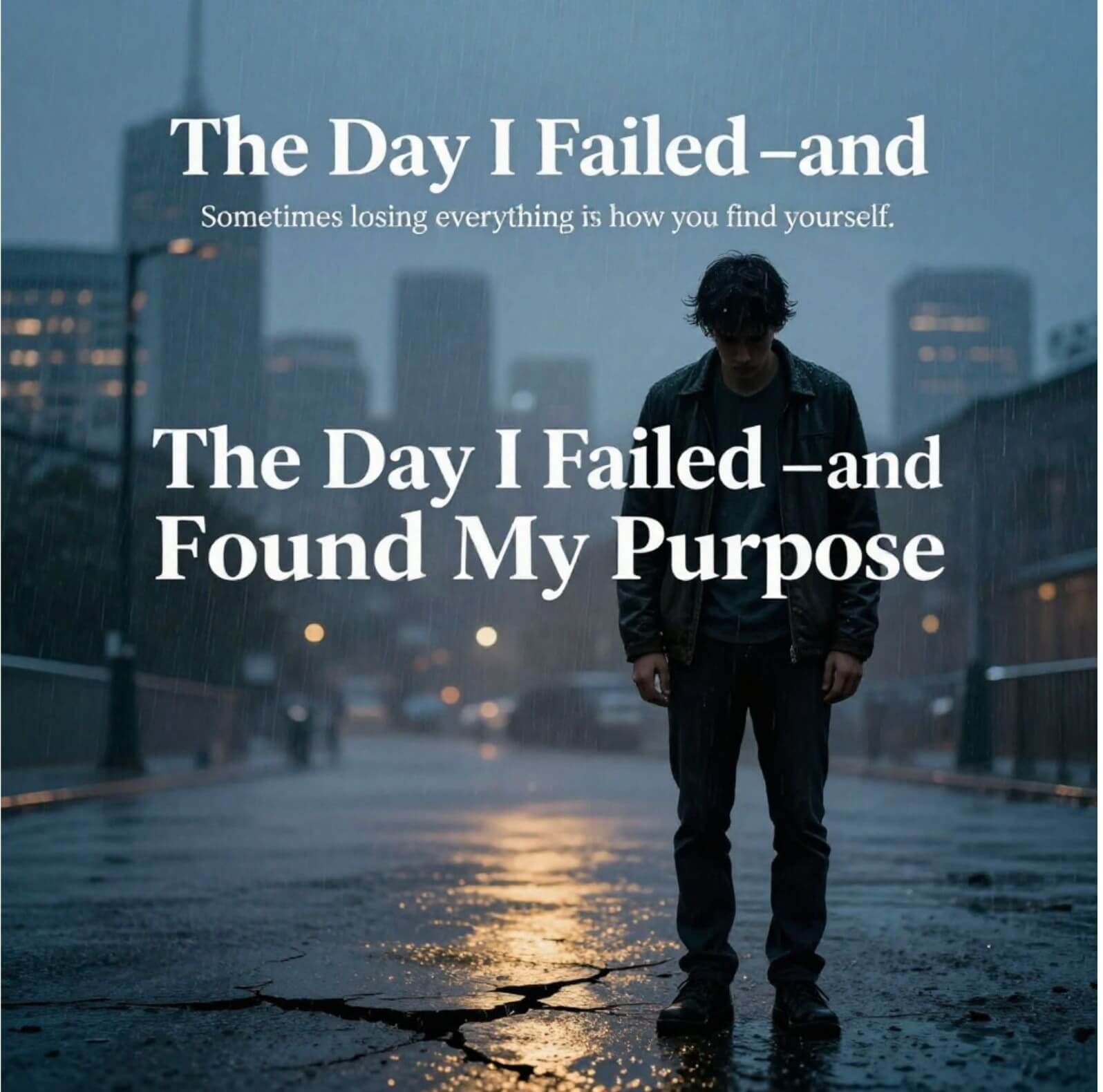
The Day I Failed—and Finally Found My Purpose
I remember the day with painful clarity—the kind that lingers long after the moment has passed, replaying itself in quiet hours and restless nights. It was the day everything I had worked for fell apart. The day I failed.
But it was also the day everything finally began.
For as long as I could remember, my life had followed a script I didn’t write but learned to perform well. Study hard. Get top grades. Make your parents proud. Secure a respectable career. Repeat.
I wasn’t forced into it—not exactly. It was more subtle than that. It lived in the approving nods when I succeeded and the uncomfortable silence when I didn’t. It thrived in comparisons, in expectations, in the invisible weight of “what people will say.”
So I became good at playing the role.
By the time I got into university, I had perfected it. I chose a course that made sense on paper—stable, respected, “safe.” Everyone around me seemed relieved by my choice. And for a while, I convinced myself I was happy too.
But deep down, there was always a quiet restlessness.
It whispered during lectures I didn’t care about. It echoed in late-night study sessions where I memorized things I didn’t believe in. It lingered in moments when I caught myself imagining a different life—one I quickly dismissed as unrealistic.
Still, I kept going.
Because quitting wasn’t an option.
The final year came faster than I expected.
That year was supposed to be the culmination of everything—my moment of proof. Proof that the sacrifices were worth it. Proof that I had stayed the course. Proof that I was… enough.
I studied harder than ever before. Or at least, I tried to.
But something had changed.
It was like my mind and my heart were no longer working together. I would sit for hours with my books open, reading the same paragraph over and over again without understanding a word. Anxiety crept in where confidence used to live.
And fear… fear became my constant companion.
Fear of failing.
Fear of disappointing everyone.
Fear of proving that maybe I wasn’t who they thought I was.
Or worse—who I thought I was.
The day of the results is etched into my memory like a scar.
I remember my hands trembling as I logged into the portal. My heart pounded so loudly I could hear it in my ears. I told myself to stay calm, but calm had already abandoned me.
When the screen finally loaded, I stared at it in disbelief.
I had failed.
Not just barely. Not in a way I could excuse or explain away.
I had failed completely.
At first, I thought there had been a mistake.
I refreshed the page. Logged out. Logged back in. Checked again.
The result didn’t change.
It was real.
And in that moment, something inside me broke.
The days that followed were some of the darkest I’ve ever experienced.
I avoided calls. Ignored messages. Stayed in my room for hours, sometimes days, barely speaking. The outside world felt too heavy, too loud, too judgmental.
But the worst part wasn’t what anyone else said.
It was what I told myself.
“You’ve wasted your life.”
“You’re a disappointment.”
“You’ve failed everyone.”
“You’re nothing without this.”
The words came relentlessly, like a storm that wouldn’t pass.
And the silence from others didn’t help.
Some people didn’t know what to say. Others said too much. A few offered comfort, but even that felt distant—like it was meant for someone stronger, someone who hadn’t fallen apart.
One evening, after days of isolating myself, my mother knocked on my door.
She didn’t come in immediately. She just stood there for a moment, as if giving me the chance to pretend I wasn’t inside.
Then she opened the door gently and sat beside me.
We didn’t speak at first.
And somehow, that silence felt different.
It wasn’t heavy or judgmental. It was patient.
Understanding.
Finally, she said something I didn’t expect.
“You’re allowed to be sad,” she said softly. “But you’re not allowed to believe this is the end of your story.”
I didn’t respond.
Because I didn’t believe her.
How could this not be the end?
Everything I had worked for—gone. Everything I thought I was—shattered.
But she didn’t try to argue with me. She didn’t force positivity or give me a lecture.
She just stayed.
And for the first time since the results, I didn’t feel completely alone.
Days turned into weeks.
And slowly—very slowly—I began to come out of the fog.
Not all at once. Not dramatically.
Just in small, almost unnoticeable ways.
I started answering a few messages. Taking short walks. Sitting outside instead of hiding in my room.
But the biggest shift came from something unexpected.
Boredom.
When you’ve spent years chasing a structured goal, failure leaves behind an uncomfortable emptiness.
No deadlines. No expectations. No clear direction.
At first, it felt terrifying.
But eventually, it became… freeing.
For the first time in my life, I didn’t know what I was supposed to do.
And strangely, that question—What now?—felt more honest than anything I had asked myself before.
I began to explore things I had once ignored.
I started writing.
It wasn’t planned. It wasn’t strategic.
One night, unable to sleep, I opened my laptop and began typing.
At first, it was just a way to release everything I had been holding in—the anger, the confusion, the pain. I didn’t care about grammar or structure. I just wrote.
And something unexpected happened.
I felt… lighter.
So I wrote again the next day.
And the day after that.
What started as an emotional outlet slowly became something more.
I began to share my thoughts online—hesitantly at first, under a pseudonym. I didn’t expect anyone to read it.
But people did.
And more than that—they responded.
They related.
They told me my words made them feel seen.
It was confusing at first.
How could something so small—something I had never taken seriously—have this kind of impact?
I wasn’t an expert. I didn’t have credentials.
All I had was my story.
But somehow, that was enough.
The more I wrote, the more I began to understand something I had ignored for years.
I had never been passionate about the path I chose.
I had been committed to it. Disciplined. Determined.
But not passionate.
Writing, on the other hand, felt different.
It didn’t drain me.
It didn’t feel like an obligation.
It felt like… me.
That realization was both exciting and terrifying.
Because it raised a new question.
What if this is what I’m meant to do?
And immediately after came the doubt.
But what if it’s not enough?
The fear didn’t disappear overnight.
If anything, it grew stronger.
Choosing a new path meant uncertainty. It meant starting over. It meant facing questions, doubts, and possibly more failure.
But this time, something had changed.
I had already failed.
And I had survived.
That realization gave me a strange kind of courage.
The kind that doesn’t come from confidence, but from experience.
I knew what rock bottom felt like.
And I knew I could climb out of it.
So, I made a decision.
Not a dramatic, life-altering announcement.
Just a quiet, personal choice.
I would take writing seriously.
I started learning.
Reading books. Taking online courses. Studying people who had built careers from words. I practiced consistently, even on days when inspiration didn’t come.
It wasn’t easy.
There were moments of doubt, rejection, and frustration.
But this time, it felt different.
Because I wasn’t doing it to meet expectations.
I was doing it because it mattered to me.
Opportunities didn’t come immediately.
In fact, for a long time, it felt like I was shouting into the void.
But slowly, things began to shift.
A small blog feature.
A freelance writing gig.
A message from someone who said my story changed their perspective.
Each moment was small on its own.
But together, they built something powerful.
Belief.
Looking back now, I can see what I couldn’t see then.
Failing that exam didn’t destroy my life.
It revealed it.
It forced me to confront a truth I had been avoiding.
That I was living a life that wasn’t mine.
Failure has a way of stripping everything down to its core.
It removes the illusions. The expectations. The identities we cling to.
And what’s left is uncomfortable.
But it’s also honest.
If I hadn’t failed, I would have continued on that path.
I would have graduated. Gotten a job. Built a life that looked successful from the outside.
And maybe, I would have convinced myself I was happy.
But deep down, that quiet restlessness would have remained.
Today, my life looks very different from what I once imagined.
It’s not perfect. It’s not always stable.
But it’s real.
And more importantly—it’s mine.
Sometimes, people ask me if I regret that failure.
If I could go back and change that day, would I?
And the answer always surprises them.
No.
I wouldn’t.
Because that day—the worst day of my life—was also the day I stopped living on autopilot.
The day I started asking real questions.
The day I finally found my purpose.
If you’re reading this and you’re in your own moment of failure, I want you to know something.
It may feel like the end.
It may feel like everything has fallen apart.
But sometimes, things fall apart so something more honest can come together.
Your failure is not your identity.
It’s not your final chapter.
It’s a turning point.
And one day, you might look back—just like I do now—and realize something unexpected.
That the day you failed…
Was the day your real story began.
Read More Stories: From Rock Bottom to Rising Strong