The Day Your Smile Rewrote My Ending
The Day Your Smile Rewrote My Ending
There are days in life that pass quietly, unnoticed, dissolving into memory like mist in the morning sun. And then there are days that split your life into two—before and after.
The day I met her was the day my story changed.
Not gradually. Not subtly.
Completely.
I wasn’t supposed to be there.
That’s the truth I always come back to. If my train hadn’t been delayed, if I hadn’t taken that unfamiliar route through the city, if I hadn’t stopped at that small, nearly forgotten bookstore to escape the rain—our paths would have never crossed.
At that time, my life felt like a story already written. Predictable. Uninspired. And if I was honest, quietly disappointing.
I was 29, working a job I didn’t love, in a city that felt too crowded yet strangely lonely. I had once believed I would become something—someone worth remembering. A writer, maybe. Someone who told stories that made people feel less alone.
Instead, I spent my days editing reports and answering emails that no one truly cared about.
Dreams, I had learned, don’t always die dramatically. Sometimes they fade quietly, replaced by routine.
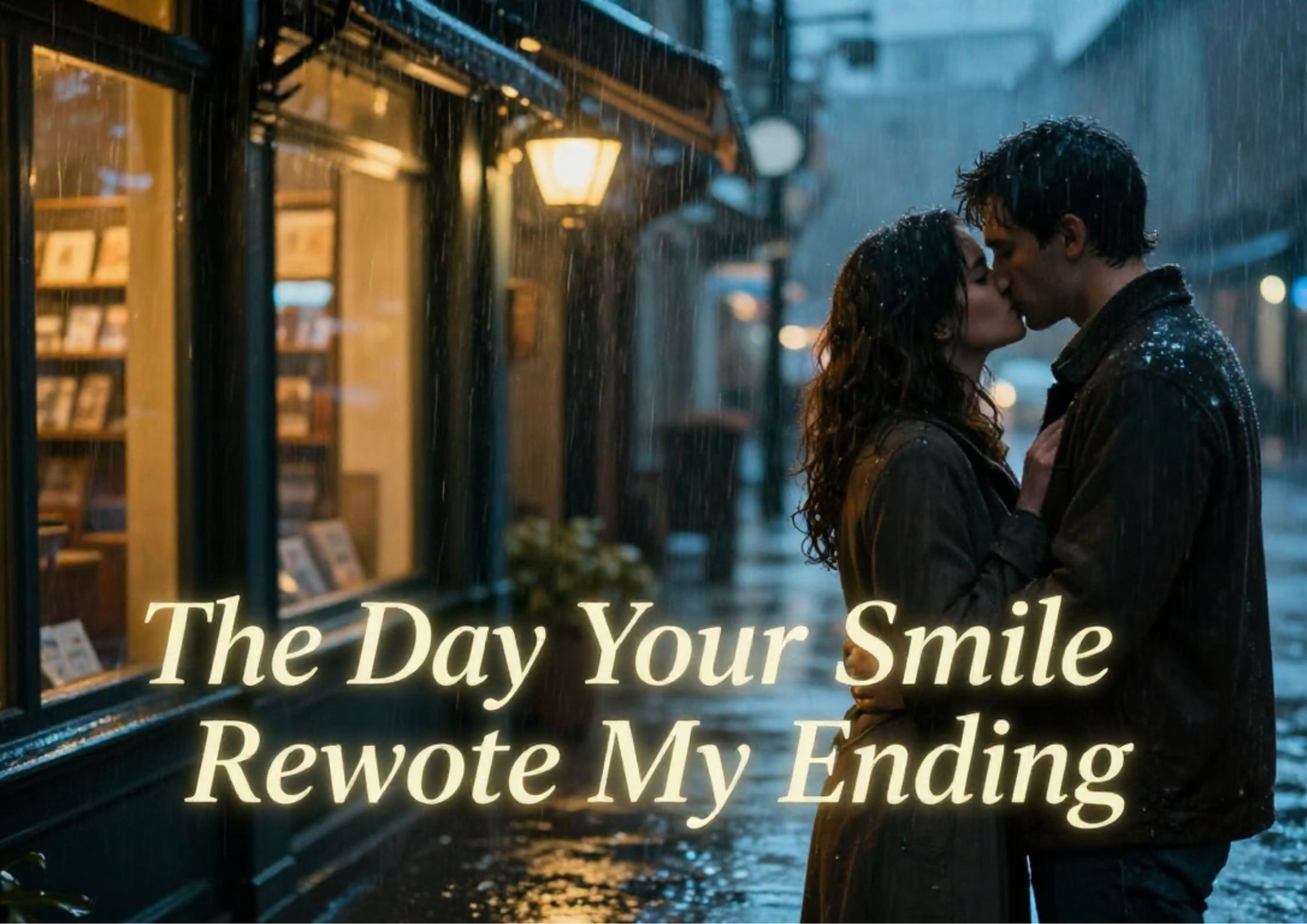
That afternoon, the sky had turned a dull shade of grey, and rain began falling in sheets, forcing people into doorways and under umbrellas. I didn’t have either.
So I ran.
That’s how I ended up in the bookstore.
It was small, warm, and smelled faintly of old paper and coffee. The kind of place you don’t find often anymore. Wooden shelves stretched from floor to ceiling, filled with books that looked like they had lived many lives before reaching this one.
And behind the counter—
She was there.
At first, I didn’t notice anything extraordinary. Just a woman arranging a stack of books, her hair loosely tied, a soft hum escaping her lips as she worked.
But then she looked up.
And she smiled.
It wasn’t a grand, cinematic moment. There was no music, no dramatic pause.
Just a simple smile.
And somehow, everything shifted.
“Escaping the rain?” she asked.
Her voice was gentle, like it belonged exactly in that space.
“Something like that,” I replied, slightly out of breath.
“Well, you’ve come to the right place. Rain tends to trap people in here longer than they expect.”
I glanced around. “I can see why.”
She smiled again, and this time, I noticed it more. Not just the curve of her lips, but the warmth behind it. The kind of smile that made you feel seen, even if only for a moment.
“I’m Emma,” she said.
“Daniel.”
And just like that, something began.
I stayed longer than I needed to.
Longer than I had planned.
Long enough to forget about the rain entirely.
We talked—at first about books, naturally. She had a way of recommending them that felt personal, as if she understood what you needed before you did.
“You don’t just read stories,” she said at one point, tilting her head thoughtfully. “You carry them.”
I laughed lightly. “Is that your professional assessment?”
“It’s my human one,” she replied.
There was something disarming about her honesty. No pretense. No effort to impress.
Just authenticity.
Before I left, I bought a book I hadn’t planned to read.
And as I reached the door, she called out, “Come back and tell me if you liked it.”
I turned, half-smiling. “What if I don’t?”
“Then come back and argue with me.”
That made me laugh.
“I’ll do that.”
And for the first time in a long while, I meant it.
I returned two days later.
Not because I had finished the book—but because I couldn’t stop thinking about her.
About the way she spoke. The way she smiled. The way she made something as simple as a conversation feel meaningful.
She looked up as the door chimed.
“You came back,” she said, as if she had expected it.
“I told you I would.”
“And? Did you like it?”
I held up the book. “I’m still reading.”
She raised an eyebrow. “So you came all this way just to say that?”
“Maybe I came to argue early.”
She laughed—a soft, genuine sound that filled the room in a way that felt almost contagious.
And just like that, it became a habit.
Days turned into weeks.
I found reasons to stop by—sometimes with books, sometimes without.
We talked about everything.
Not just stories on paper, but the ones we carried inside us. Dreams. Fears. Regrets. The things we rarely say out loud.
Emma had a way of asking questions that made you confront parts of yourself you had long ignored.
“Why did you stop writing?” she asked one evening as we sat on the floor between shelves, surrounded by books.
I hesitated. “Life got in the way.”
“That’s not an answer.”
I sighed. “I guess… I got scared.”
“Of what?”
“Of not being good enough. Of trying and failing.”
She studied me for a moment, her expression thoughtful.
“Do you know what I think?” she said softly.
“I’m almost afraid to ask.”
“I think you stopped because you care too much. And somewhere along the way, you decided it was easier to give up than to risk proving yourself wrong.”
Her words hit harder than I expected.
Because they were true.
Emma wasn’t just someone I spent time with.
She became someone who changed the way I saw things.
The way I saw myself.
She challenged me—not harshly, but persistently. Encouraging me to pick up a pen again. To write, even if no one ever read it.
“Stories don’t need permission to exist,” she told me. “Neither do you.”
So I started writing again.
At first, it was awkward. Forced.
But slowly, something began to return. A spark I thought I had lost.
And with it came something else.
Hope.
Somewhere along the way, I fell in love with her.
Not suddenly.
But in quiet moments.
In the way she tucked her hair behind her ear when she was thinking. In the way she laughed at things that weren’t particularly funny. In the way she believed in people—even when they didn’t believe in themselves.
Especially then.
But I didn’t say anything.
I was afraid.
Afraid of losing what we had. Afraid of complicating something that felt… perfect.
Until one evening, she changed everything.
“Do you ever feel like time is… fragile?” she asked suddenly.
We were sitting outside the bookstore, watching the sky shift into dusk.
“Fragile how?”
“Like it doesn’t always give you as much as you think it will.”
I frowned slightly. “That’s a bit philosophical.”
She smiled faintly. “Humor me.”
I considered it. “I guess… yeah. Sometimes.”
She nodded, as if confirming something to herself.
“Then promise me something,” she said.
“What?”
“That you won’t wait too long to say the things that matter.”
Her words lingered in the air between us.
And in that moment, something in me shifted.
“I love you,” I said.
It came out quietly. Honestly. Without rehearsal.
She looked at me, her eyes widening slightly—not in shock, but in something deeper.
Then she smiled.
That same smile.
The one that had changed everything the first day.
“I was wondering how long it would take you,” she said softly.
My heart skipped. “So… that’s not a rejection?”
She laughed gently. “No, Daniel. It’s not.”
And just like that, the world felt brighter.
Loving Emma felt like stepping into a version of life I hadn’t believed was possible.
Everything felt more vivid. More real.
We spent our days between books and conversations, and our evenings exploring the city—finding beauty in places I had long overlooked.
And through it all, I kept writing.
Not because I had to.
But because I wanted to.
Because she reminded me that stories mattered.
That my story mattered.
But happiness, I would learn, is rarely untouched by shadows.
It started subtly.
Missed days at the bookstore.
Shortened conversations.
A tiredness she couldn’t quite hide.
At first, she brushed it off.
“Just exhausted,” she said.
But I knew something was wrong.
And eventually, she told me.
Emma was sick.
The kind of sick that doesn’t come with easy answers.
The kind that changes everything.
I remember sitting there, trying to process her words, feeling the same helpless disbelief I had once imagined only existed in stories.
“How long have you known?” I asked.
“A while,” she admitted.
“And you didn’t tell me?”
“I didn’t want to change things,” she said softly.
“It already has.”
She nodded. “I know.”
Fear became a constant companion after that.
Not loud. Not overwhelming.
But always there.
And yet, Emma remained… Emma.
She still smiled. Still laughed. Still believed in moments.
“Don’t look at me like I’m disappearing,” she told me once.
“I’m trying not to.”
“Then don’t try. Just be here.”
So I was.
The day everything changed again came quietly.
Too quietly.
She was weaker, her voice softer, but her eyes—her eyes still held that same light.
“Are you still writing?” she asked.
“Every day.”
“Good,” she whispered. “Then promise me something.”
“Anything.”
“Finish your story.”
I swallowed hard. “I will.”
“And don’t make it a sad one.”
I tried to smile. “I’ll do my best.”
She looked at me, her expression gentle, knowing.
“You already have,” she said.
She passed away that night.
And for a while, the world felt… empty.
Like a book missing its final chapter.
But grief, like love, changes over time.
It softens. It reshapes.
And slowly, I began to understand what she meant.
A year later, I stood in that same bookstore.
Only now, it was mine.
Emma had left it to me.
Along with a note.
“Stories deserve a home. So do you.”
I still think about her every day.
In the quiet moments.
In the pages I write.
In the smiles of strangers who walk through that door.
But I also live.
I write.
I love.
Because she taught me how.
And sometimes, when the light hits just right, I swear I can still see her—
Standing behind the counter.
Smiling.
The same smile that rewrote my ending.
Read More Stories: Falling for You in Borrowed Time